

Table of Contents
Dubai: Nearly seven months into the US-Iran war, the UAE’s hospitality sector is no longer operating in crisis mode — but neither is it back to business as usual.
Sign up for our daily business newsletter, Cheques & Balances
The common thread running through conversations with hotel operators, consultants, asset managers and travel platforms is that the appetite for the UAE has not disappeared. What has changed is how, when and where people are booking — and how hard hotels have to work to convert that interest into revenue.
International leisure and long-haul travel have taken the biggest blows, booking windows have shortened and price competition has gotten intense. Corporate and MICE demand has become more cautious in some segments, while luxury has been particularly exposed.

That leaves the industry entering the next phase with a more complicated question: is this a recovery, or simply a series of temporary rebounds?
Paul Clifford, co-founder of strategy and communications firm Context Studio and a hospitality commentator, puts it bluntly: “While it’s not panic stations now or crisis mode, the damage is still being felt.”
“Where there have been small recoveries there has been something that has set the situation back again,” he said, warning that “until mass tourism returns, the progress won’t be a gamechanger”.
That said, hotels may have guests in rooms again, but that does not necessarily mean profitability has returned to pre-war levels.
“Those who are coming are on cheaper package deals or all-inclusive offers that also bring in a different kind of guest to hotels and the city, meaning overall spend is lower,” Clifford said. “It’s good to have people in hotels, but those who are there won’t be driving full recovery for the businesses.”

Booking has changed
For many hotel operators, the clearest evidence of the shock has not been an outright collapse in demand, but a change in customer behaviour. René Egle, general manager of JA The Resort, said the past six months had required the resort to become “more agile”.
“The underlying appetite for Dubai remains strong,” he said, but geopolitical developments created periods of hesitation, particularly in some international markets.
The more noticeable change, he said, was that guests were taking longer to commit and, in some cases, booking much closer to arrival, which has also made forecasting harder.
Saurabh Tiwari, vice-president, Operations – Middle East, Maldives and Sri Lanka at The Indian Hotels Company Limited (IHCL) – the operator of Taj group of hotels, also pointed to shortened booking windows across his UAE portfolio. “Guests who would traditionally book several weeks or months ahead are increasingly making decisions much closer to their travel dates,” he said.
“That has made forecasting more challenging, but it has also demonstrated how quickly demand can return once confidence improves.” Tiwari was recently promoted as VP operations for the region.
Krystel Irani, general manager at Al Zorah Beach Resort, also described the same pattern, saying guests had become more cautious, with international leisure travellers particularly likely to delay decisions until closer to their travel dates.

International demand takes the hit
The pressure has also been uneven across customer segments.
At JA The Resort, Egle said March to May saw the greatest pressure, particularly from international travellers.
At Al Zorah Beach Resort, Irani said the impact was also most pronounced during the March-to-May high season, when the property would normally benefit from strong international leisure demand and higher-yielding bookings.
Clifford said the picture was particularly difficult for luxury hotels, while international corporate travel had also suffered.
“Luxury has really taken a hit,” he said. “Corporate and business travel isn’t happening as insurance is problematic for international visitors.”
He added that the US market was missing, while India remained dominant.
The recovery of European traffic could provide some relief, but not immediately.
“We’re seeing European flights scheduled for the end of the year, which will help but not until the festive period,” Clifford said.
That creates a difficult bridge for hotels: they have to manage through the months before some of the traditionally important international markets return in greater numbers.
Staycations step in
One of the sector’s recurring safety nets has been the domestic market.
Tiwari said his portfolio increased its focus on UAE staycations and short-haul GCC business, using targeted weekend and value-added packages rather than simply cutting room rates.
That has been an important strategy across the sector, particularly as international travel became less predictable.
Meanwhile, Trip.com’s data points to a wider shift towards travel closer to home.
Elaine Sun, accommodation business market director, Middle East and Africa at Trip.com, said GCC travellers had increasingly turned their attention towards intra-regional travel and staycations when international travel became more uncertain.
“When international travel becomes more uncertain, people don’t necessarily stop travelling,” she said. “They look for experiences that are closer to home, easier to access and give them greater confidence and flexibility.”
Trip.com recorded triple-digit year-on-year growth in hotel room nights on its GCC local sites in the first half of 2026. Dubai remained the platform’s number one destination for hotel bookings across the GCC.
However, there is an important caveat to that resilience. Clifford said he was seeing “very little traffic from GCC guests”, with residents taking advantage of cheaper deals instead.
The two views highlight the unevenness of the market: staycations and regional travel are cushioning the sector, but that does not mean every hotel, segment or price point is benefiting equally.

Events are filling the gap
There is another force helping the UAE hospitality sector: the sheer frequency of events taking place across the country.
The packed Middle East Film and Comic Con (MEFCC) over the weekend, alongside a steady stream of smaller community events, is a visible reminder that people continue to spend on experiences even when international travel decisions are being delayed.
For hotels, restaurants and attractions, that matters. Major events can generate spikes in room demand, while smaller community events can keep local residents moving around the destination.
But hotel executives themselves caution against confusing event-driven peaks with a full recovery. Egle said the sector needs to see sustained performance across several consecutive months rather than simply benefiting from traditional high-demand periods.
The indicators he is watching include healthy occupancy combined with rate strength, longer booking windows, improved international demand and greater confidence from group and MICE customers.
“A genuine recovery, therefore, is not just 80 per cent occupancy in December,” said Tiwari, making a similar distinction.
“It is healthy occupancy combined with rate growth, stronger RevPAR, longer booking lead times and a balanced mix of leisure, corporate and MICE demand.”
The rate problem
Perhaps the most difficult issue facing hotels now is what happens to rates.
When demand becomes less predictable and booking windows shrink, hotels are competing for last-minute customers. That can create pressure to discount.
Irani said the luxury hospitality market was experiencing unusually pronounced pricing pressure, with operators increasingly prioritising occupancy and volume growth.
“Many operators are increasingly prioritising occupancy and volume growth, resulting in heightened competition and greater pressure on average rates across the sector,” she said.
Tiwari described demand volatility and its impact on rates as the most immediate commercial pressure facing his portfolio. But both operators stressed that discounting is not necessarily the answer.
At JA The Resort, the strategy has been to create more value around the stay through dining, resort experiences, leisure and family activities rather than competing on room rates alone.
Tiwari said his hotels were using packages, partnerships and targeted offers while remaining disciplined on rates.
That is increasingly important because hotels are not dealing with demand pressure alone. Operating costs remain elevated.
Busy does not mean profitable
For hotel owners, the challenge goes beyond filling rooms.
Joao Cravo, vice-president, Asset Management at Trilight Hospitality Asset Management, said payroll, utilities, maintenance, insurance, distribution and procurement were all putting pressure on the amount of revenue that ultimately reaches the bottom line.
“Owners need to look beyond occupancy and ADR,” he said.
“We spend a lot of time looking at flow-through, payroll productivity, channel costs, departmental profitability and whether F&B, leisure and other facilities are genuinely contributing to EBITDA.”
His conclusion is particularly stark: “A busy hotel is not necessarily an optimised hotel.” That is likely to shape the next stage of the market.
As hotel owners reassess assets and management agreements, the conversation is shifting from simply attracting guests to determining how efficiently each hotel converts revenue into cash flow.
A tougher test ahead
That could make the next six months more consequential than the first six.
Clifford expects the period to remain difficult, particularly with Ramadan falling early in 2027. “I can’t see much expansion happening at all,” he said, although hotel deals continue to be announced across the region for projects further into the future.
He also expects some hotels that closed for refurbishment to take longer to return. “I wouldn’t be surprised if many get pushed towards the end of the year or 2027,” he said.
Cravo sees travel disruption and short-term uncertainty as the biggest risks for owners over the coming six months, particularly because they affect trading, cash flow and forecasting reliability.
Many ownership groups, he said, are already revisiting forecasts and reassessing cash flows.
For assets approaching the end of their hotel management agreements, the disruption could also become a stress test.
Owners are increasingly asking operators to demonstrate their economic contribution, including how much business their reservation, loyalty and distribution systems actually generate.
“The objective should not be to renegotiate for the sake of it,” Cravo said. Instead, owners need to determine whether changes to commercial terms, operating models or brand relationships can strengthen the asset for the next cycle.
But the demand is still there
The more optimistic reading is that the underlying travel appetite has survived. Trip.com reported double-digit year-on-year growth on its platform and said hotel room nights across its GCC local sites grew by triple digits in the first half of 2026.
Sun said short- and medium-haul travel had increased and accounted for more than 80 per cent of preferences in the company’s data.
Travellers were still taking international holidays when they felt confident about the destination and journey, with strong summer travel to Turkey, Indonesia, Thailand and China.
The problem for the Middle East is therefore less about whether people want to travel — and more about whether they can get there with confidence.
“Travellers don’t necessarily distinguish between individual countries or cities in the same way that people working in the industry do,” Sun said.
“They may look at the region as a whole and ask themselves: Can I get there safely? Will my flight operate? What happens if the situation changes?”
That confidence gap is arguably the biggest challenge for the UAE hospitality sector now.
ATM comes at a critical moment
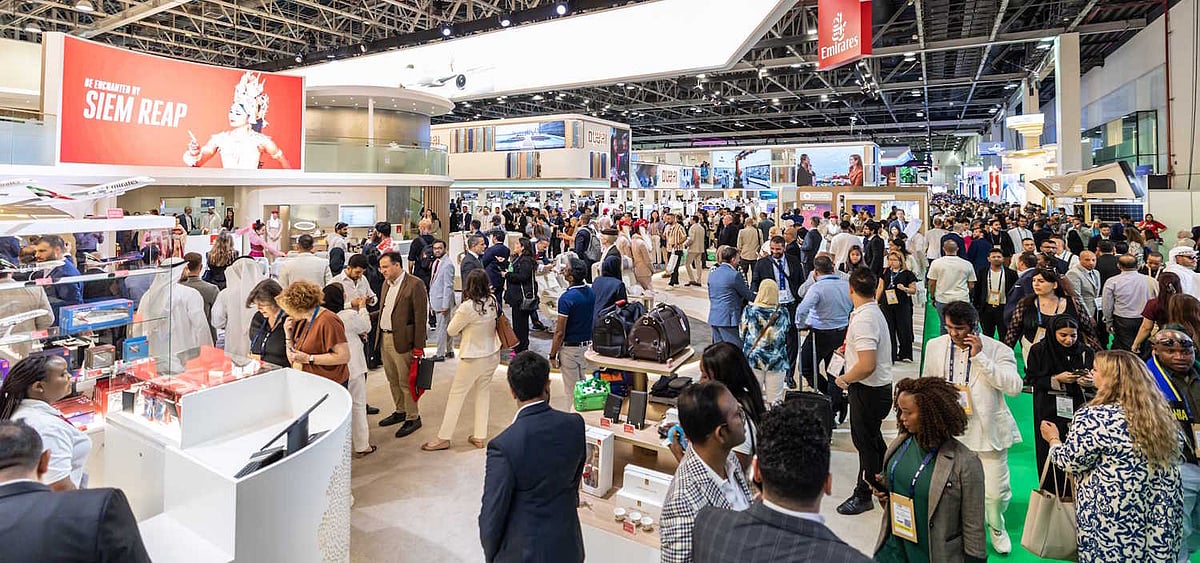
Against that backdrop, Arabian Travel Market returns to Dubai at a particularly important point for the industry.
ATM is bringing destinations, airlines, hotels, tourism businesses and travel companies together after months of disruption — giving the industry a chance to rebuild commercial relationships and assess where demand is moving next.
Issam Kazim, CEO of Dubai Corporation for Tourism and Commerce Marketing, said the event reflected Dubai’s role as a global meeting point for the travel industry and a platform to strengthen international partnerships.
All said, there is zero appetite among hotel operators and other travel and tourism stakeholders to abandon the UAE. Tiwari said IHCL was not scaling back its expansion or investment plans and remained committed to its Accelerate 2030 growth strategy.
Existing hotels continue to invest in rooms, restaurants, wellness, technology and guest experience, although investment is being phased carefully.
At JA The Resort, Egle said short-term volatility had not changed the property’s long-term view of Dubai. Irani likewise said Al Zorah remained committed to enhancing the guest experience and investing for the long term.
UAE’s hospitality sector has already demonstrated that it can absorb shocks. The harder task now is proving that the recovery is durable.
As Egle put it, the industry needs several consecutive months of healthy occupancy, strong rates, longer booking windows and stronger international, corporate and MICE demand before it can confidently call the downturn over.