
Dubai: Apple’s rise from a struggling computer maker to a company worth about $4.8 trillion rests on two contrasting leadership periods.
Sign up for our daily business newsletter, Cheques & Balances.
Steve Jobs rebuilt the business around a small number of breakthrough products. Tim Cook took that foundation, expanded it globally and developed a services ecosystem generating more than $100 billion a year.
Get updated faster and for FREE: Download the Gulf News app now – simply click here.
The distinction is often presented as innovation versus execution. The financial record shows something more connected: Jobs created the devices and platforms that restored Apple’s relevance, while Cook found ways to sell them at greater scale, retain customers and generate recurring revenue long after the initial purchase.

For investors, both periods produced exceptional gains. Yet the calculations depend heavily on the purchase date and whether dividends are included.
Jobs cut Apple back before building it up
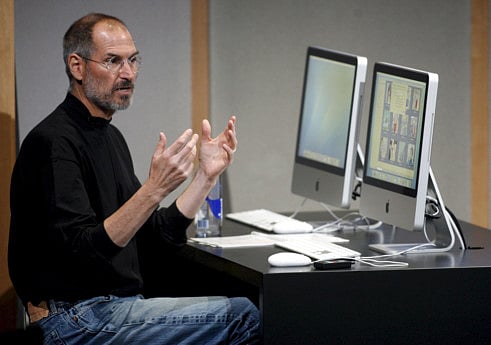
Jobs returned to Apple when the company acquired NeXT in 1997. He became its de facto leader after chief executive Gil Amelio left in July and was formally named interim CEO on September 16.
Apple was then losing money and carrying a confusing range of products. Jobs sharply reduced that portfolio and concentrated resources on a smaller number of computers aimed at consumers and professional users.
The iMac arrived in 1998, followed by the iPod in 2001, the iPhone in 2007 and the iPad in 2010. Apple also developed the software and distribution systems that made those devices more valuable, including iTunes and the App Store.
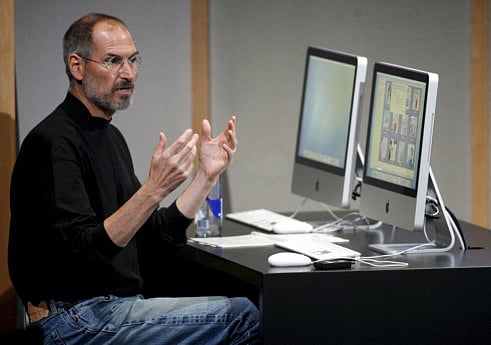
This was not innovation limited to individual products. Apple increasingly controlled the hardware, operating system, software distribution and retail experience. That integration helped the company keep customers within its ecosystem.
By the time Jobs resigned as CEO on August 24, 2011, Apple’s market value stood at roughly $350 billion. Earlier that month, it had briefly challenged ExxonMobil for the position of the world’s most valuable listed company.
Jobs left behind a highly profitable business built around the iPhone, which was already becoming Apple’s main commercial engine. He also left the App Store, the platform that would support much of the services growth associated with Cook’s tenure.
Cook turned reach into recurring revenue
Cook inherited a different challenge. Apple no longer needed rescuing, but investors questioned whether it could maintain its momentum without Jobs.
His response centred on scale. Drawing on his supply-chain background, Cook expanded manufacturing, improved procurement and supported the global distribution of increasingly complex product launches.
Apple introduced the Apple Watch in 2015 and later built AirPods into another major product line. Apple Pay, Apple Music, Apple TV+, iCloud subscriptions and other services widened the ways in which the company earned revenue from its installed base of devices.
Cook also oversaw Apple’s move away from Intel processors in Mac computers. The transition to Apple-designed silicon gave the company greater control over performance, energy efficiency and the timing of product development.
Services became one of the clearest measures of that strategy. Apple generated $109.16 billion from services in its 2025 financial year, up from $96.17 billion a year earlier, according to its regulatory filing. Total annual revenue reached $416.16 billion.
Services now include the App Store, advertising, cloud services, digital content, payment services and AppleCare. They produce recurring income and reduce Apple’s dependence on customers replacing hardware every year.
That did not eliminate the importance of the iPhone. Rather, the device became the gateway through which Apple sold a growing range of accessories, subscriptions and digital services.
From $350 billion to about $4.8 trillion
Under Cook, Apple became the first US-listed company to cross market values of $1 trillion, $2 trillion and $3 trillion.
At a share price of about $325 on September 1, 2026, its market capitalisation stood near $4.8 trillion. That was almost 14 times its approximate value when Cook took charge.
The increase in market value exceeded the rise in annual revenue. Investors placed a higher value on Apple’s brand, cash generation, installed customer base and services income. Extensive share buybacks also reduced the number of shares outstanding, increasing the portion of the company represented by each remaining share.
Cook’s tenure still carried strategic questions. Apple’s most commercially important product remained the iPhone, which originated under Jobs. The company also faced scrutiny over its App Store practices and pressure to strengthen its position in artificial intelligence.
Those issues form part of the inheritance passed to John Ternus, who succeeded Cook as chief executive in September 2026. Cook moved to the role of executive chairman.
What happened to a $1,000 investment?
Apple completed a seven-for-one stock split in 2014 and a four-for-one split in 2020. Historical prices must therefore be adjusted before they can be compared with today’s share price.
Apple closed at $376.18 on August 24, 2011, when Jobs resigned and Cook was appointed. After adjusting for the two subsequent splits, that equals about $13.44 a share.
At $325.13, the stock delivered a price gain of roughly 2,320 per cent during Cook’s tenure.
A $1,000 investment made at the close on August 24, 2011, would therefore be worth about $24,200 before accounting for dividends, taxes or trading costs. Reinvesting Apple’s dividends, which resumed in 2012, would raise the total.
The return from 1997 was much larger than the estimate in the original calculation. Apple’s split-adjusted share price averaged about $0.13 during July 1997, though the exact figure varies by date and whether historical dividends are included.
At that approximate entry price, $1,000 would have bought close to 7,700 shares. Those shares would be worth around $2.5 million at $325 each.
Using September 16, when Jobs formally became interim CEO, would produce a different result because Apple’s share price had already moved. Any comparison should therefore state the precise purchase date instead of referring broadly to the time Jobs “returned”.
The contrast between the two eras is clear. Jobs generated the turnaround and established Apple’s defining products. Cook converted that product strength into a wider, more predictable and substantially more valuable business.