

Table of Contents
Dubai: An unannounced meeting of President Donald Trump’s senior national security team at Camp David, combined with a major US military buildup in the Middle East, is sharpening questions over Washington’s next move against Iran.
There is no confirmation that Trump has decided to resume large-scale attacks. But the developments are giving him significantly greater military options just as efforts to negotiate an end to the war appear to have hit another deadlock.
Here is what we know — and what the signals could mean.

Why does the Camp David meeting matter?
Vice President JD Vance chaired Friday’s several-hour meeting, which was not announced by the White House.
Secretary of State Marco Rubio, Defence Secretary Pete Hegseth, special envoy Steve Witkoff, CIA Director John Ratcliffe and Joint Chiefs Chairman Gen. Dan Caine were among those attending, according to Axios, citing three US officials.
Iran and the Saudi-Houthi conflict in Yemen were discussed.
One US official told Axios that decisions were made or issues were at least discussed in depth. The White House has not said what was decided.
The setting adds to the significance. A similar meeting of senior Trump administration officials took place at Camp David in June 2025, days before Israel went to war with Iran.
That precedent does not mean another major operation is imminent, but Friday’s gathering comes at a particularly sensitive moment.
What is happening militarily?
The Pentagon is substantially increasing the forces available to Trump in the Middle East.
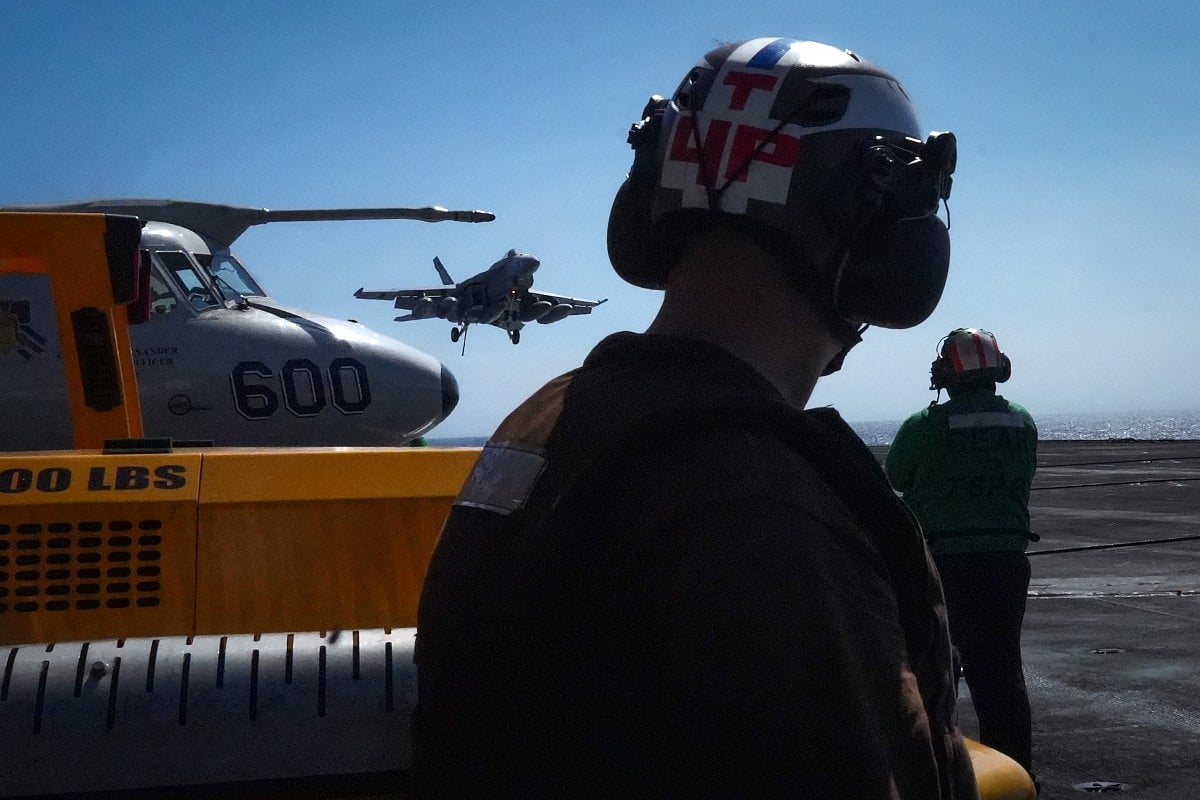
The USS Theodore Roosevelt carrier strike group and USS Makin Island Amphibious Ready Group are being sent to the region as part of a deployment that could add 9,000 to 10,000 US personnel.
They will join a large American force already deployed in the region.
If planned deployments overlap, the US could have three aircraft carrier strike groups and two amphibious groups available in the Middle East — giving commanders considerably greater offensive and defensive capability.
Some of the movements may involve replacing forces that have already spent months deployed rather than preparing for a new offensive.
But the effect is the same: Trump would have a much larger military toolbox if he decides to intensify operations against Iran.
What is Trump saying?
Trump is deliberately leaving his intentions unclear.
He told TIME that renewed US military action against Iran after the November midterm elections was “possible” if Washington and Tehran failed to reach an acceptable agreement.
Speaking on Thursday, Trump said he believed the war would be won “right after the election,” before adding that it could happen earlier.
He also described Iran as “ready to fold up.”
Then on Friday, as his advisers met at Camp David, Trump was asked what he planned to do next.
“If I told you, you would have a major story,” he said, before adding: “You will see.”
Is diplomacy still alive?
Yes — but it is struggling.
Qatar has been trying to bridge the differences between Washington and Tehran, but the two sides remain far apart.
Trump rejected Iran’s latest proposal, which included reopening the Strait of Hormuz under conditions that included sanctions relief and changes to the US blockade.
The US is simultaneously increasing economic pressure. Washington has widened sanctions against Iran while maintaining measures that have severely restricted Tehran’s oil exports.
There was another sign of deteriorating relations on Saturday when two members of Iran’s delegation to the UN General Assembly left the United States after Washington said they had failed to comply promptly with an order to leave.
Iran has disputed Washington’s broader account of its delegation’s departure, saying its schedule had been arranged in advance.
Why strengthen US defences too?
Because any renewed American attack could trigger Iranian retaliation.
Tehran still possesses missiles and drones and has threatened a stronger response if large-scale US attacks resume.
Washington has reinforced regional defences, including additional Patriot air-defense systems, while the growing naval presence provides protection as well as offensive firepower.
The Strait of Hormuz remains particularly sensitive, with recent attacks on commercial vessels underlining the risk to shipping and energy supplies if fighting escalates.
And what about Yemen?
Iran was not the only issue discussed at Camp David.
US officials told Axios that the Saudi-Houthi conflict in Yemen was also on the agenda as Washington considers how far it is prepared to become involved.
That makes Friday’s meeting potentially about more than the next phase of the Iran war. Trump is weighing decisions that could affect two interconnected conflicts across the region.
So, what is Trump up to?
For now, Washington appears to be creating options rather than signalling a final decision.
The military buildup can strengthen Trump’s negotiating hand while simultaneously preparing the US for renewed combat if diplomacy fails. The additional defensive systems also help Washington prepare for Iranian retaliation.
But the combination of an unusual Camp David meeting, stalled diplomacy, mounting economic pressure and thousands of additional US personnel heading towards the region means the military option is becoming increasingly credible.
Whether that force is ultimately used — or whether its presence helps produce a deal — remains the unanswered question.