

Table of Contents
Dubai: Iran’s Revolutionary Guards claim to have seized a US REMUS 600 underwater drone in the Strait of Hormuz, putting a little-known but increasingly important part of modern naval warfare in the spotlight.
The US military has denied the claim, with US Central Command saying it has “positive control of all of our operational drone assets”.
The IRGC Navy said it intercepted the unmanned underwater vehicle, or UUV, during what it described as a reconnaissance mission following a “coordinated intelligence and electronic warfare operation”. It claimed the vehicle had been handed to Iranian military experts to retrieve its data.

So what are underwater drones, how do they work — and why are they particularly useful in a strategic waterway such as the Strait of Hormuz?
تنگه هرمز نه تنها باز نیست، بلکه شکارگاه نیروی دریایی سپاه برای زیرسطحیهای آمریکایی است؛ دومین شکار هم صید شد، اینبار Mk 18 Mod 2 Kingfish؛ یک AUV پیشرفته، خودمختار، مجهز به سونار و ناوبری دقیق و با ارزش چندمیلیوندلاری. فقط شکار نیست؛ غنیمت فناوری و اطلاعاتی است. pic.twitter.com/S47rAjjbP9
— سخنگوی سپاه (@Irgcspeaker) September 27, 2026
What is an underwater drone?
Think of it as a robotic submarine without a crew.
Underwater drones generally fall into two categories. Remotely operated vehicles, or ROVs, are typically connected by a cable to a surface vessel and controlled by an operator.
Autonomous underwater vehicles, or AUVs, can be programmed to travel along a route and perform missions largely on their own.
According to Deep Trekker, a Canadian manufacturer of underwater robotic systems, underwater drones combine cameras, sonar and other sensors to inspect, survey and document submerged environments without putting divers at risk.
Are underwater drones new?
Far from it.
The US Navy pioneered early remotely operated underwater vehicles in the 1950s, initially developing machines to retrieve lost equipment and perform deep-sea inspections.
Underwater robots later became important in oceanographic research and offshore industries. Technology developed with US Navy involvement was also used in the exploration of famous shipwrecks including the Titanic.
By the 1980s, improvements in electronics, cameras, propulsion and materials had expanded their use in the oil and gas industry for inspecting underwater infrastructure.
The major technological leap was autonomy: vehicles no longer necessarily needed to be tethered to a ship or continuously controlled by a human operator.
What is the REMUS 600?
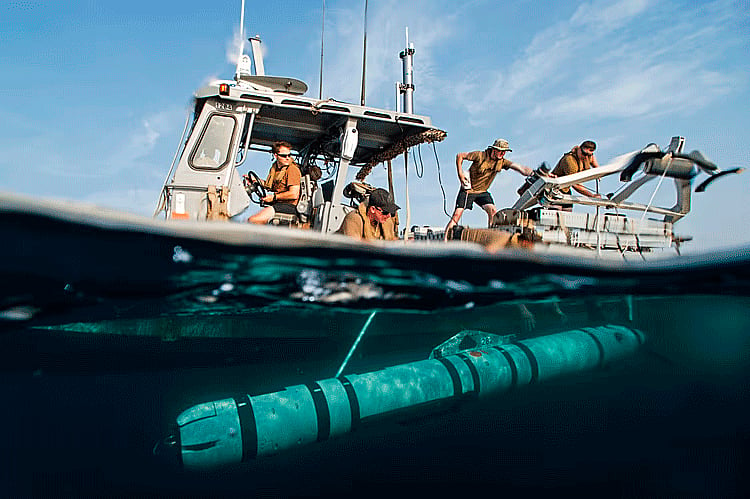
REMUS stands for Remote Environmental Monitoring UnitS.
The REMUS family was originally developed for oceanographic work and later adopted for military missions. The systems are now produced by US defence and shipbuilding company HII.
The REMUS 600 is a medium-sized autonomous underwater vehicle designed to operate at depths of up to 600 metres.
It is relatively compact compared with crewed submarines and larger unmanned underwater vehicles.
Once given its mission, an AUV can travel through the water gathering information with its onboard sensors before returning for recovery.
What can it actually see underwater?
One of its most important tools is sonar.
Deep Trekker says sonar is particularly valuable in murky waters, where suspended particles can make conventional cameras ineffective, allowing operators to navigate and detect objects even in poor visibility
Depending on its sensors, a UUV can map the seabed, locate potential mines, identify underwater structures and collect detailed information about its environment.
Cameras can then provide images when visibility and distance permit.
But how does it navigate without GPS?
This is one of the fascinating differences between aerial and underwater drones.
GPS signals do not penetrate seawater effectively. An underwater vehicle therefore cannot simply navigate in the same way as a car or aerial drone.
Instead, UUVs can combine technologies including inertial navigation, depth sensors, sonar and acoustic positioning to calculate where they are and follow a programmed route.
Some missions can be conducted largely autonomously, with the vehicle storing information until it returns or surfaces.
Can operators communicate with it underwater?
Yes, but not nearly as easily as they can communicate with an aerial drone.
Radio waves used for normal communications do not travel effectively through seawater. Underwater vehicles can use acoustic communications, but these have limitations in speed and bandwidth.
That makes autonomy particularly important. Instead of a human operator constantly telling the drone where to go, the vehicle can be programmed to complete much of its mission by itself.
Why use one instead of a submarine?
Risk and cost.
A crewed military submarine is a hugely valuable platform carrying sailors. Sending one into potentially dangerous waters simply to survey the seabed or search for mines may be unnecessary when a much smaller unmanned vehicle can perform the job.
UUVs are particularly attractive for missions that are dangerous, repetitive or time-consuming.
Mine hunting is a prime example. A drone equipped with sonar can search potentially mined waters without exposing divers or the crew of a minesweeper to the same danger.
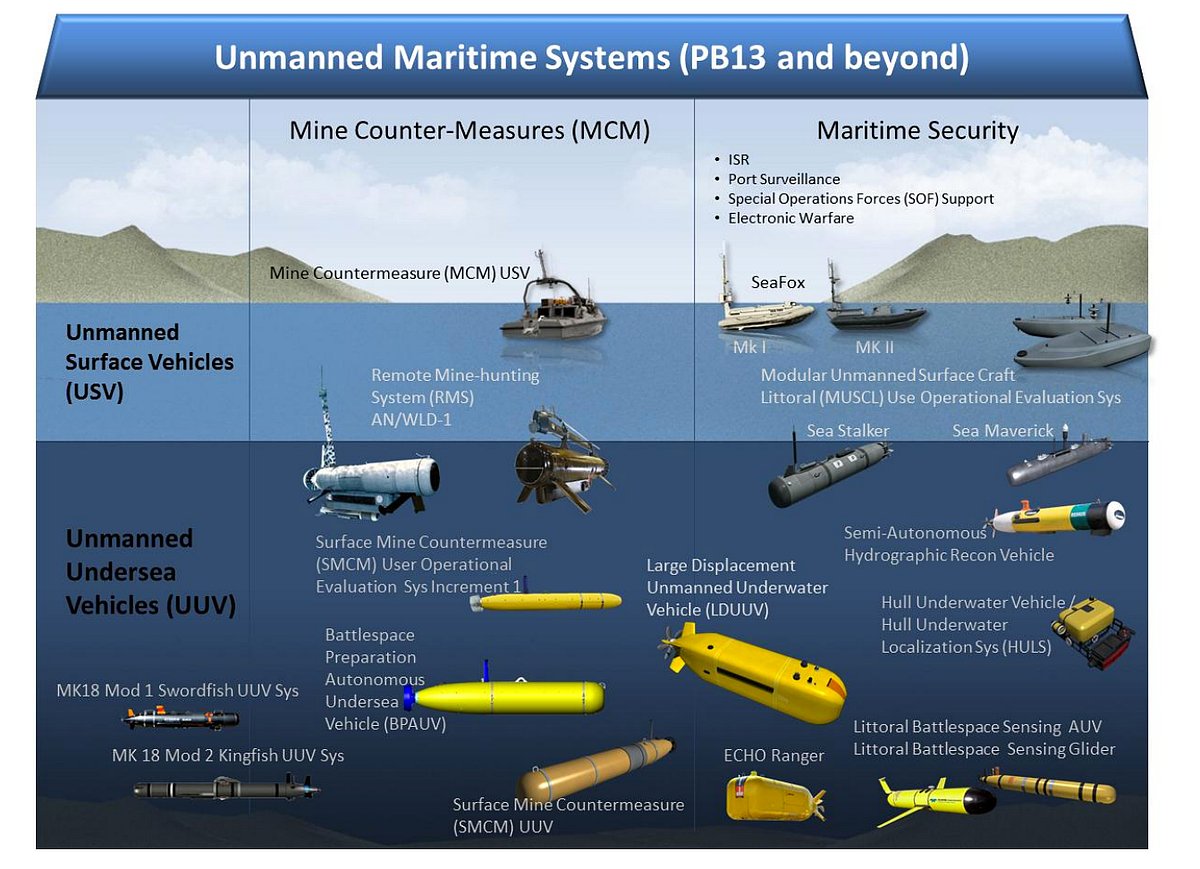
The US Navy has consequently explored UUVs for mine countermeasures, intelligence gathering, surveillance and anti-submarine missions.
Can they operate from submarines?
Yes — and that greatly expands their potential reach.
Some underwater drones can be deployed from surface vessels, while others can operate from submarines or shore facilities.
This allows a larger vessel to remain farther away while the unmanned vehicle enters an area to survey, map or collect information.
It also means the presence of an underwater drone does not necessarily reveal exactly where its supporting vessel is located.
Why do they matter in the Strait of Hormuz?
Geography makes underwater awareness particularly important there.
The Strait is narrow, strategically vital to global energy shipments and heavily monitored by regional and international militaries.
Knowing the underwater environment can help naval forces understand shipping routes, seabed features, potential mine locations and other hazards.
UUVs can gather some of that information without deploying a crewed vessel directly into a potentially dangerous area.
That makes mine detection particularly significant. Mines can threaten both naval and commercial vessels and potentially disrupt shipping through a strategic waterway.
What happens if an underwater drone is captured?
That is what makes Iran’s claim especially interesting.
If an autonomous vehicle malfunctions, becomes disabled or is intercepted, another country could potentially recover it.
The value may extend beyond whatever information the vehicle has collected.
Military specialists could be interested in its sensors, sonar, navigation equipment, communications systems, software and other technology.
Iran specifically claims that the REMUS 600 it seized has been handed to military experts “to retrieve its data”.
However, that claim has not been independently established — and CENTCOM says it retains positive control of all its operational drone assets.
Has Iran made such a claim before?
Yes.
The latest announcement is the second recent Iranian claim involving US-made underwater equipment.
The IRGC previously said it had intercepted a Dive-LD autonomous underwater vehicle, manufactured by US defence company Anduril, near the entrance to the Strait of Hormuz.
Are underwater drones only military?
No. In fact, much of the technology has important civilian uses.
Underwater robots inspect oil and gas pipelines, offshore installations, dams, ship hulls and other submerged infrastructure.
Scientists use them for ocean research and seabed mapping, while they can also assist in search-and-recovery operations.
Their fundamental attraction is the same whether the operator is a navy, scientist or energy company: They can enter deep, dangerous or difficult underwater environments without sending a human being.
Are they the future of naval warfare?
They are increasingly becoming part of it.
Navies are exploring everything from relatively small mine-hunting vehicles to much larger autonomous systems capable of travelling long distances and carrying different payloads.
Researchers have even experimented with biomimetic UUVs designed to move like fish, while other concepts envisage underwater systems lying dormant until activated for a mission.
But underwater drones still face major challenges. Communications are difficult, batteries limit endurance and navigating autonomously beneath the surface is far harder than operating in the open air.
For now, they complement rather than replace submarines, surface ships and divers.
But Iran’s disputed claim has highlighted a part of modern military competition that is normally invisible: the growing contest beneath the waves.