

Table of Contents
Dubai: Vijay Sethupathi’s Maharaja has spent well over a year building a reputation far beyond its original Tamil release, and the recent news of a Hindi remake and a possible Hollywood adaptation has brought fresh attention to a film that many hadn’t expected to travel quite this far. Here’s a closer look at what the film is actually about, and why it’s become such a talking point.
The setup: a barber and a missing dustbin
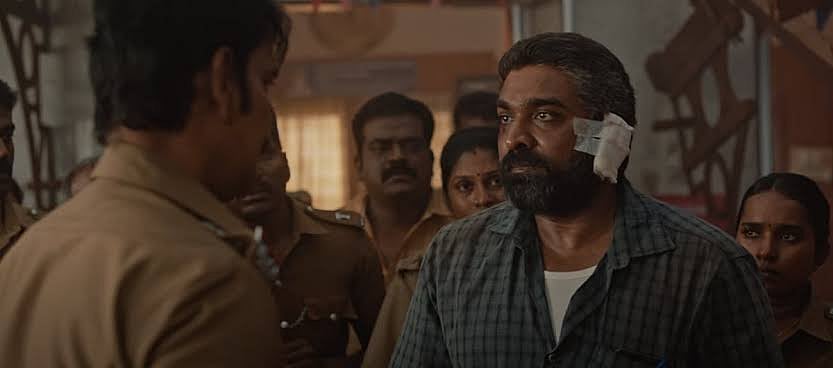
Maharaja follows a quiet, introverted barber named Maharaja, played by Vijay Sethupathi, who raises his daughter Jothi alone in Chennai after a family tragedy. When burglars break into his home, attack him and steal a possession he refers to only as “Lakshmi,” Maharaja walks into the local police station to report the theft. What follows is a scene that sets the tone for the entire film: the police, expecting to hear about a stolen person, discover Lakshmi is in fact an old metal dustbin, and treat Maharaja as a sentimental eccentric wasting their time.

He doesn’t let it go. Maharaja returns to the station day after day, insisting the case be taken seriously, eventually offering a bribe to get the police to actually investigate. That persistence, and the audience’s growing curiosity about why a dustbin matters this much to him, becomes the engine driving the rest of the story.

A structure built to confuse you, on purpose
What makes Maharaja stand out isn’t just its central mystery but how it’s told. The film deliberately runs several storylines in parallel that, on the surface, appear entirely unconnected: Maharaja’s search for Lakshmi, a wealthy man furious over stolen sunglasses, and a separate burglary at another affluent household involving a two-faced thief named Selvam, played by Bollywood filmmaker Anurag Kashyap. For much of the first half, these threads seem to belong to different films entirely.
That confusion is intentional. Reviewers at the time compared the opening stretch to something closer to a straightforward revenge thriller in the vein of John Wick, only for the screenplay to reveal itself as far more layered as the connections between the storylines start to surface in the second half. Without spoiling exactly how the pieces come together, the reveal has become one of the most talked-about twists in recent Tamil cinema, reframing everything that came before it.
A story about fatherhood at its core
Beneath the thriller mechanics, Maharaja is ultimately built around a father-daughter relationship. Director Nithilan Saminathan, making his second feature after Kurangu Bommai, structured the film to blend action with family drama, and Sethupathi has spoken about how central that relationship was to what drew him to the project in the first place. Speaking to Variety, he described the experience of making the film simply. “We do all the films with so much fear and passion. We just wanted to do what we had imagined. We didn’t expect this. Of course, I’m happy.”
Why it became such a big deal
Maharaja marked Sethupathi’s 50th film as a lead actor, initially announced under the working title VJS50 before its official name was revealed. Shot in a single schedule largely across Chennai on a modest budget of around ₹20 crore (approximately Dh7.66 million), the film went on to gross close to ₹190 crore (roughly Dh72.77 million) worldwide, a substantial return that helped cement it as one of the standout Tamil releases of 2024.
Its success wasn’t confined to India either. The film performed strongly in China following its theatrical release there, an unusual feat for a Tamil film, and found an even wider audience once it landed on Netflix, where its layered storytelling and twist-driven structure made it the kind of film that generated repeat viewings and online discussion long after its theatrical run had ended.

Critically, the film was praised for its screenplay and editing as much as its performances. Sachana Namidass, making her major film debut as Maharaja’s daughter Jothi, won the National Award for Best Supporting Actress for her role, adding an official accolade to what had already become a word-of-mouth hit. Anurag Kashyap’s performance as the morally ambiguous Selvam also drew significant attention, seen as one of the stronger acting turns of his career outside his usual directing work.
Where the story goes from here
Maharaja’s momentum has continued well past its original release. A Hindi-language remake is reportedly in the works, with Aamir Khan’s production house said to have acquired the rights and Aamir himself expected to take on the lead role. Separately, director Nithilan Saminathan has confirmed that a sequel, Maharaja 2, is in active development, with the script now locked. Producer Sudhan Sundaram has also confirmed that the film has drawn interest from a Hollywood agency for an English-language remake, following its strong performance in China, though full details on that project, including casting, remain unconfirmed.
For a film that began as a modestly budgeted story about a man refusing to give up on a stolen dustbin, Maharaja has ended up becoming one of the more unlikely, and enduring, success stories to come out of Tamil cinema in recent years.