
Table of Contents
Manila: For decades, Mount Pinatubo has symbolised catastrophe in the Philippines.
The volcano, about 100km north of Manila, had been dormant for roughly 500 to 600 years. This long “sleep” lulled nearby communities into thinking the mountain was inactive.
When it erupted on June 15, 1991, it unleashed one of the largest volcanic explosions of the 20th century.

The blast was so powerful the cloud of ash and sulphate particles deflected enough sunlight to cool the planet.
Pinatubo spewed an estimated 10 cubic kilometres of ash and aerosols high into the stratosphere, blanketing much of Central Luzon in thick tephra.
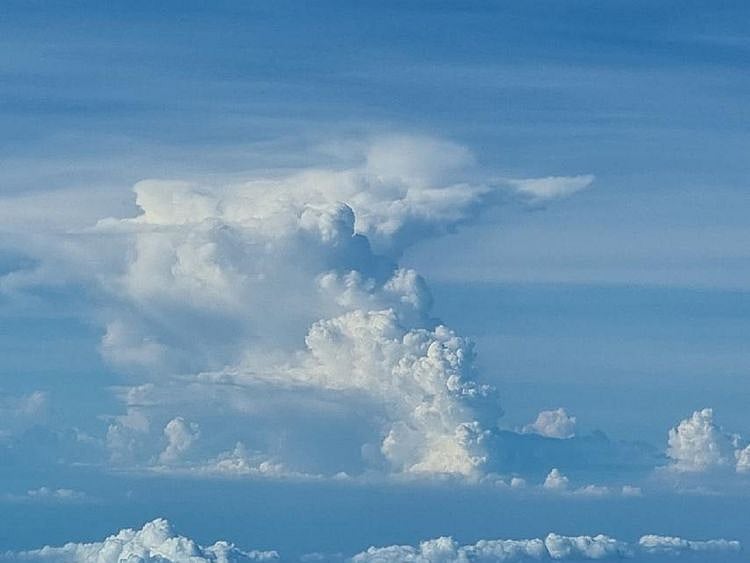
The eruption killed more than 800 people directly and indirectly.
It destroyed tens of thousands of homes, and buried farmland and infrastructure under metres of ash.
It displaced more than 1.2 million people in 1991, and also forced the US military to abandon Clark Air Base, its biggest military facility ouside mainland America. The US Navy also left nearby Subic.
In the years that followed, rain triggered “lahars” — fast-moving slurries of ash, rock, and water— being swept down river valleys.
Hundreds more were killed, and communities were displaced, repeatedly burying roads, bridges, and towns under metres of sediment.
Now, the very ash that devastated communities could one day help power a high-tech future.
As global demand for semiconductor materials surges and countries seek alternative sources of silica, scientists and engineers are exploring silica-rich ash from Pinatubo.
Quick look at silicon melting in progress. High heat transforms solid silicon into molten purity. This is where the journey of solar panels and semiconductors begins. #SiliconMelting #Polysilicon #SolarEnergy #Semiconductor #MaterialsScience #Metallurgy pic.twitter.com/Z3nGQJbGAi
— IDM Metallurgy (@IDM__Metallurgy) September 11, 2026
Why silica matters for chips
Silicon, derived mostly from silica (silicon dioxide, SiO₂), is the backbone of modern electronics. Integrated circuits and microprocessors require ultra-pure “electronic-grade” silicon, often refined to 99.999% purity (known as 9N) or higher, to ensure reliable performance at the nanoscale.
Most commercial semiconductor silicon comes from high-purity quartz sand or specially refined precursors, not from ordinary volcanic deposits.
Volcanic ash and lahar, including those from Pinatubo, are rich in silica.
Studies of Philippine volcanic materials show that ash and lahar deposits can contain substantial amounts of SiO₂. This makes them theoretically attractive as raw material for silicon production.
A De La Salle University research project on lahar from Mount Pinatubo found that silica extracted from these deposits could, in principle, be used for semiconductor applications — but only after extensive purification to reach at least 98.99% purity.
The purification challenge
The main challenge: not the presence of silica, but the impurities that come with it.
Raw volcanic ash typically contains iron, aluminum, calcium, magnesium, and other oxides that interfere with semiconductor manufacturing.
Even after basic chemical extraction and “leaching”, the resulting silica often falls far short of the 9N standard required for chip-grade silicon.
Research on other volcanoes illustrates the gap.
Work on Mount Sinabung’s ash in Indonesia, for example, shows that coprecipitation and acid-leaching methods can recover silica with purities in the mid-90% range, suitable for some industrial uses but still below semiconductor thresholds.
Similar studies on volcanic ash from Merapi and other systems report comparable results: promising for glass, ceramics, or concrete additives.
But for microprocessors, it requires further, energy-intensive refining.
For Pinatubo lahar, the De La Salle study concluded that while the material is a “viable” silica source, turning it into semiconductor-grade silicon would require multi-stage purification.
This would likely involving multiple acid treatments, solvent extraction, and possibly zone refining or chemical vapour deposition steps.
The processes are not only technically demanding, they’re also capital-intensive.
It marks the next challenge for Philippine manufacturing, amidst the push to ramp up industrialisation along the so-called “Luzon Economic Corridor” under “Pax Silica” vision.
Economic and environmental trade-offs
Even if the chemistry works, economics and logistics matter.
Pinatubo’s lahar deposits are widespread but dispersed, and much of the material has already been mined for construction fill, road base, and land reclamation.
Setting up a dedicated supply chain for chip-grade silicon would require new mining, transport, and processing infrastructure, as well as strict quality control to ensure consistent feedstock.
Environmental considerations
There are also environmental considerations.
Large-scale extraction and chemical processing could generate hazardous waste streams if not carefully managed.
This could potentially repeat some of the ecological damage caused by the eruption and subsequent lahars.
On the other hand, using existing lahar deposits could reduce pressure on natural quartz reserves and offer a form of “productive remediation,” turning a long-standing hazard into an economic asset for affected communities.
From disaster to semiconductor age
Using best-practices in “productive remediation,” a well-studied and well-funded use of this natural resource can turn a long-standing hazard into an economic asset for affected communities.
The human toll of the Pinatubo disaster was real: More than 1.2 million people were displaced in 1991, and lahar flows continued to threaten lives and livelihoods well into the 2000s.
Yet the idea that the same material that destroyed homes and farms could someday help build the chips that power phones, computers, and AI systems offers a compelling narrative of resilience and innovation.
For now, Pinatubo’s silica remains a promising but challenging feedstock.
It underscores a broader challenge of the semiconductor age: the materials that enable our digital world are abundant in nature, but transforming them into high-purity/high-performance components is one of the most demanding industrial tasks humanity has undertaken.
If used properly and managed well, Pinatubo’s legacy may yet expand beyond disaster management and climate science to include a quiet role in the global challenge for secure, diversified sources of semiconductor materials.
The challenge for the Philippines today is to put together the technology, investment, and governance can align to make it feasible, or just sit on it for centuries to come, perhaps until the next eruption.