

Table of Contents
Down a rather solemn row of buildings in Al Quoz sits a studio lit low enough to feel like a confession booth, guitars leaning against every wall, drums waiting, cables coiled in the corner. It takes a while to untangle them, but much like their own songwriting and production process, the band perseveres through every knot, waiting to unravel the next one.
And here’s where we meet Karman Line. It’s a Tuesday morning, but there’s no sign of lethargy in the room. It’s bustling with energy: The guitars are being tuned, wires are being plugged in, and the members look to find space on a four-seater couch, dismissing any sign of discomfort.
Four of the band’s five members are already here. The fifth is somewhere out in Dubai’s arteries, stuck in traffic , though, mercifully, not for long.

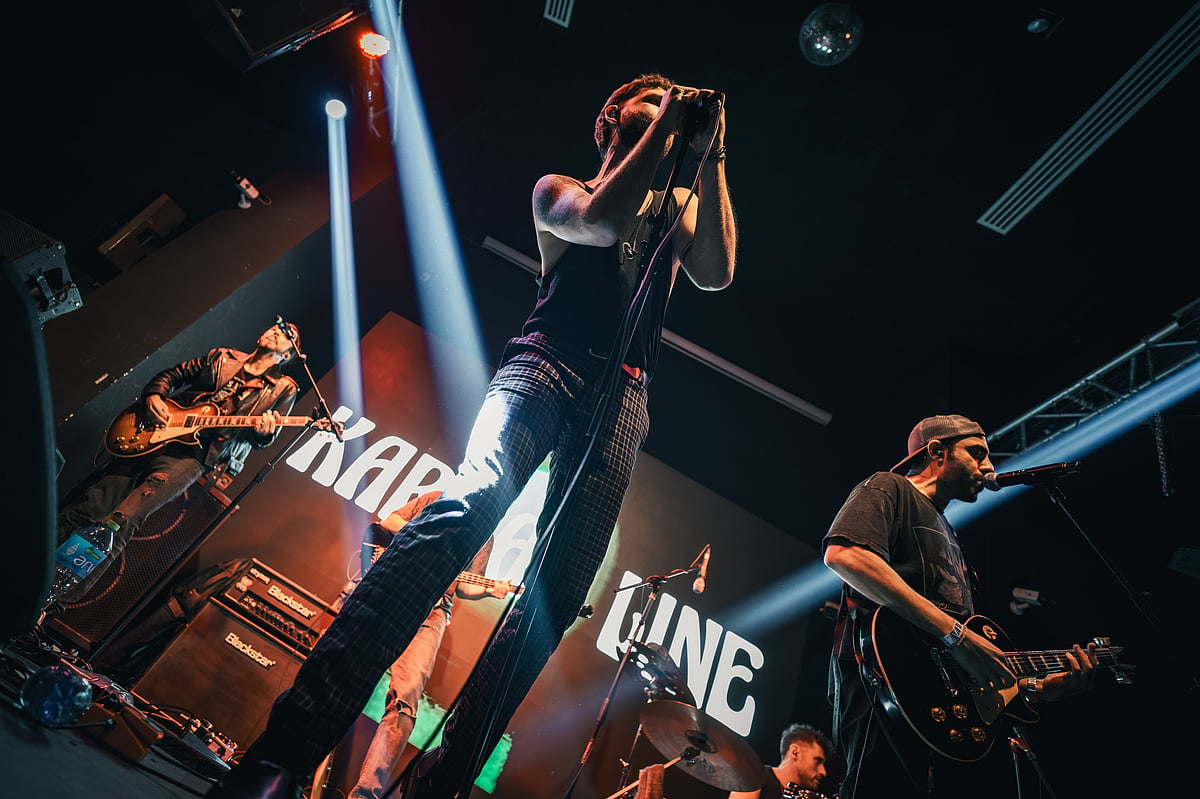
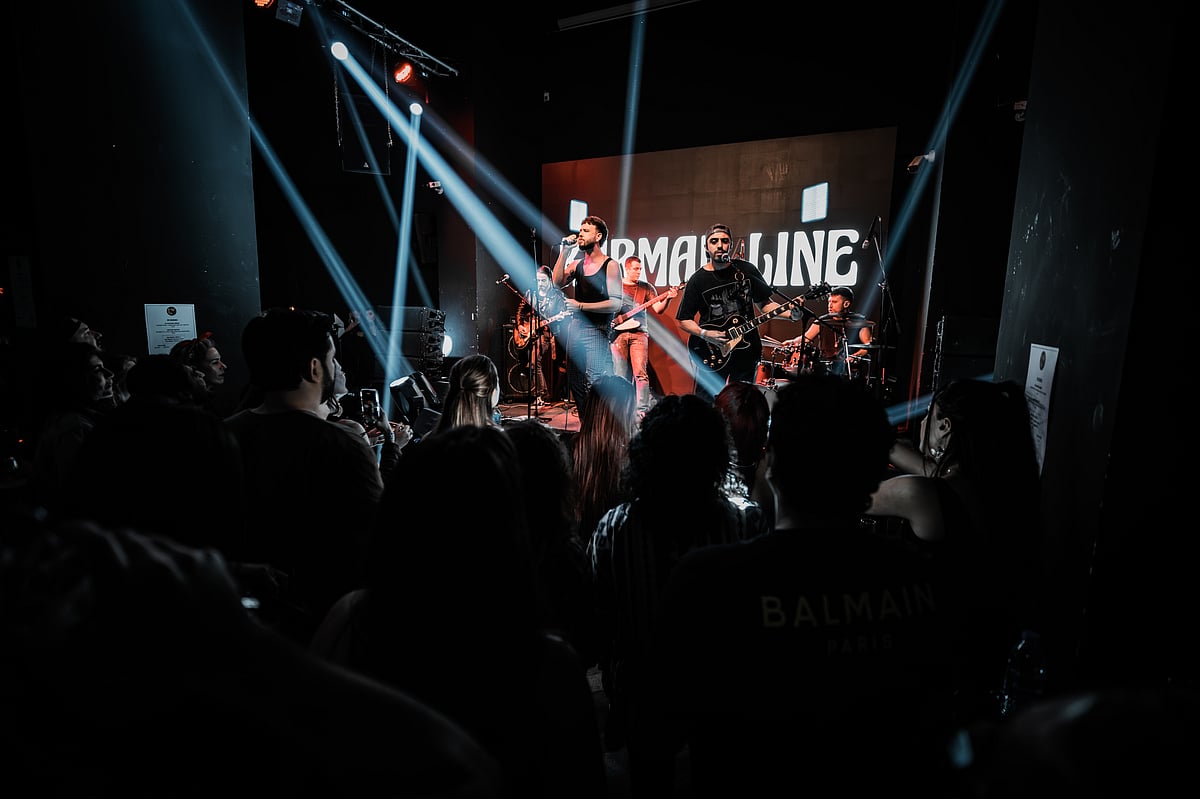
Karman Line is Greg Brown on lead vocals and guitar, Frank Bassiouni on lead guitar and backing vocals, Simone Nisi on guitar, Petar Milošević on bass, and Danny Langston on drums. For Brown and Milošević, the band’s time together is something carved out of demanding day jobs, including advertising and aviation.

It started with a few acoustic guitars
Karman Line’s beginnings trace back to the pandemic, when the world’s stillness handed its future members something they rarely had before: hours to spend on an idea they’d been circling for years.
“We started writing some music, and we ended up getting together, I think it was once a week, on a Thursday night,” says Brown. As he notes, it was just a couple of guitars, a rented slice of evening, and the slow accumulation of ideas.
“It was like 8 o’clock to 10 o’clock or something, just working on songs with a couple of acoustic guitars,” Brown recalls. “And then it became 10 songs.”

Along the way, the project stopped being a pandemic hobby and started being a band. Petar joined soon after, rounding the group out to a full five-piece, and they began working with producer Sandeep Sikera, a friend Brown credits with helping sculpt the raw material into something resembling an album.
It took the better part of two years, but the record eventually made its way to Metropolis Studios in the UK for mixing and mastering before landing back home for its launch at The Fridge in Dubai in 2023. “It feels like forever ago now,” Brown says, with the faint disbelief of someone measuring time in songs rather than years. “But yeah, it did really well, and we were super happy with it.”
More than a finished product, the album became a launchpad. “It just set the tone,” Brown says. “We thought, okay, now we’ve got something cool we can work with here, and we want to keep the momentum a little bit.”

Making music between jobs
The image of a rock band spending its days chasing nothing but the next song is, for Karman Line, still mostly aspirational.
“It’s not a full-time thing. I wish it was,” Brown admits.
For years, rehearsals and recording sessions had to be wedged into the cracks of ordinary working life. Bassiouni remembers his own version of that juggling act clearly, a banking job, weekend commutes from Sharjah into Dubai, and stray hours spent writing songs at Brown’s balcony, whenever the week allowed. Brown, meanwhile, was building a career in advertising, and Petar was, and still is, cabin crew. “I’m the only one flying,” he says. “He’s always flying,” the other note.

Bassiouni has since crossed over entirely. “I’m not in banking now. I’m a full-time musician now,” he says. And as he explains, it’s the fire of motivation and the drive to keep them going.
For Brown, that remains the horizon line. “I still think, at least within me, that’s the goal,” he says. “Managing to do this on the side of normal, regular work stuff, maybe it’s an end goal for me, and something I can work towards to jump into full-time, eventually.”
A band shaped by different musical journeys
Five different roads lead to the same destination.
Bassiouni began at seventeen, when he left home chasing the idea of becoming a guitarist. He would later return to formal education, studying fine arts, but the stage never really let go of him. “I had to go out and explore,” he says. “From 17, I went on stage and tried this life, and yeah, I think that’s who I am.”
Petar’s route was stranger and more circuitous, starting not with rock at all, but with rap, and a teenage diet of 50 Cent, before a group of friends redirected him entirely. “I got into a company of rockers, and they actually introduced me to this kind of music,” he says. His father’s record collection did the rest, feeding him a steady stream of ZZ Top and other relics of eighties and nineties rock.
“I started with an acoustic guitar,” he says. “We had a professor in our high school who was giving free classes, so I just went with my friend, and I’m the only one who remains playing until today.” That was more than fifteen years ago.
His path to Karman Line ran, through Bumblefoot, the former Guns N’ Roses guitarist. He shared a stage with him at a guitar clinic in Dubai, a performance that caught the attention of Karman Line’s then-guitarist, Tristan. “He invited me into the band. I met Greg, and COVID started, months after.”
And so, they built something out of the wreckage of that year. “We actually made an album during COVID,” he says. “I think that was the best part of it.” Petar adds, only half-joking, and is quick to claim the distinction: “I think we are the only band in the UAE who made a full album during COVID.”
For Simone, the guitar arrived earlier still. “I just started to play the classical guitar, actually, when I was 10, in Italy. And I never stopped,” he says. The classical grounding eventually gave way to electric guitar in high school, then a jazz university education, and finally a move to the UAE to chase music as more than a pastime.
On the other hand, Langston has been involved with music full-time, since he was 17. “I’ve been doing it full-time, since I could. If you love it, and you can put the time for it, then you do it.”
However, he does admit, “There’s a lot of backend before you become a musician. There are hours and hours of practice, and you keep going.” As he hints, there’s no ‘finish line’; you just keep polishing your talent, and look for the next step.
Some of those songs, it turns out, had been waiting in the wings even before the pandemic gave them a reason to exist.
Five influences and a sound
With five musicians who arrived at rock from five different directions, Karman Line’s sound was always going to be a collision rather than a single vision.
A song typically begins as a fragment, a chorus or verse one of them might bring in from a solitary evening at home, before the rest of the band gets its hands on it and the shape starts to shift. “That’s only one form of what the song can be,” Brown says. “But then when we get together, you really hear everybody’s influences playing into it. We don’t step on anyone’s toes, what makes it whole is all of those things coming together,” Brown says. “That’s what makes our sound.”
Petar frames the process as each member reading the intent behind another’s idea and carrying it forward. “Everyone would have a vision when they write a part,” he says. “I think our role as members is to see that vision through.” Only then does the individual signature return. “Whenever we add our own taste to it, it makes a difference,” he says.
Everyone writes
There is no single pen behind Karman Line’s songs. “We usually write songs in our own spaces, and when we have our studio sessions, we share ideas with each other,” Brown says.
There’s an entire archive of these ideas, he says. Ideas arrive independently, scraps of melody, half-written verses, and are only really finished once they hit the studio and the whole band leans in. Some are written with a specific session or show in mind; others wait, patiently, for their moment to be useful.
The accumulating archive of half-finished ideas is now feeding directly into the band’s second album. “If we’re not busy practising or rehearsing for our next show, we can always dip into that and say, okay, we want to work on this idea and that idea,” Brown says. The next record, it seems, will be built from both fresh instinct and old, unfinished business.
The next album will not sound like the first
For a band with an album already behind it, nostalgia holds far less appeal than momentum. Brown calls that debut ‘a solid starting point’ — generous, but firmly past tense, and the group now sounds more energized by where the music is heading than by where it’s been.
“As a band, you constantly have to evolve instead of doing the same thing over and over again,” he says.
The restlessness is already shaping expectations for record number two. “We’re all fairly excited about the sound that we’ve got these days and what this next record is going to sound like,” Brown says.
They wish to push their standards higher, as Bassiouni adds.
Bringing the UAE’s rock scene to a wider audience
Karman Line’s ambitions don’t stop at their own discography. Having watched the UAE’s rock and metal community shift and mature over the years, the band is convinced it has already outgrown its old, underground reputation, even if the rest of the world hasn’t caught up yet.
Brown, who has been part of the scene since around 2013, has watched that evolution up close. “I’ve seen it go through so many cycles,” he says.
As he explains, the music itself has left the underground behind; what’s missing is recognition beyond the country’s borders. The term ‘underground scene’ almost seems outdated and rather contrived: It’s very much over ground as they note, and music exists for those who wish to see it. The scene isn’t in singular; there are multiple scenes across the country, in the form of gigs, open mics, garage performances, and one step always leads to another.
“A lot of the world doesn’t see this place as somewhere that has a metal and rock scene,” he says. That, for Brown, is where the “underground” label still clings on. “It doesn’t have the international exposure,” he says.
It’s a gap KarmanLine wants to help close, not just for themselves, but for the community around them. “There’s so many great bands here and people are really trying to push the envelope and do cool things with their music in the city,” Brown says.
From Dubai to the UK, Europe and Scandinavia
That ambition now has a concrete outlet. KarmanLine has signed with international touring agency Redline Music, which will pitch the band for shows, and opening slots with larger acts, across the UK, Europe and Scandinavia in 2027.
It’s a distance to travel for a band that started with two-hour Thursday night sessions and a couple of acoustic guitars.
But there’s more at stake than KarmanLine’s own stage time. The band sees the tour as a chance to carry the wider UAE music scene along with them, putting it in front of audiences who may not know it exists. “It’s a good opportunity to get our music out and to also put more of a view on the UAE music scene as well,” Brown says.
The wires are untangled now. What KarmanLine plays next is up to them.