

Table of Contents
*Gulp*
The backpack hits the floor, and the floor is strewn with worksheets. The child wants to play, the mother would really love to sleep too, but the homework must be done. Sigh.
So, in the wake of much discussion around homework for children, here’s the question: Is homework really good for a child or is troubling their childhood?

What the science says about a child’s developing mind
Sarkis Gudjelian, a psychologist at The Hummingbird Clinic, Dubai, doesn’t believe there’s a straightforward verdict. “A question like this cannot be answered with a simple yes or no because the developmental benefits of homework depend largely on the child’s age and on the type and amount of homework being assigned,” he says.
The reasoning traces back to how children actually think at different ages. From a developmental perspective, younger children learn extensively through exploration, play, direct experience, and interaction with their environment, as Gudjelian explains, invoking Piaget’s stages of cognitive development.
In Piaget’s framework, children between approximately 2 and 7 years are in the preoperational stage, during which symbolic thought develops but logical operations are not yet fully established. Therefore, learning activities that are experiential, playful, and connected to the child’s immediate environment may be particularly appropriate at this stage.

That doesn’t mean homework is inherently bad for young children, but it does mean expectations should shift with age. Instead, research suggests that the academic benefits of traditional homework are more limited in younger children than in older students.
As children mature, their reasoning abilities catch up to the demands of traditional assignments. For instance, as Gudjelian explains: Around the age of 7, children gradually enter Piaget’s concrete operational stage, during which they become increasingly capable of logical reasoning about concrete information. As children move toward adolescence, they gradually develop more advanced abstract and hypothetical reasoning.
At these stages, appropriately designed homework can become more useful for practicing, consolidating, and reinforcing academic concepts that require repetition and processing over time.
How to reframe the question entirely
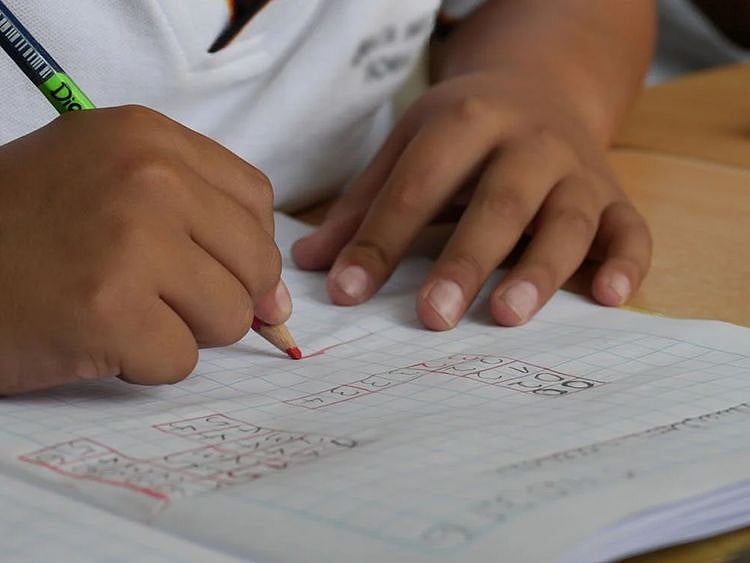
So instead of a blanket rule, Gudjelian suggests reframing the question entirely. “Rather than asking whether children should or should not receive homework, it may be more appropriate to ask whether the homework is developmentally appropriate, meaningful, and balanced with opportunities for play, exploration, social interaction, and experiential learning.”
Even once a family accepts homework as necessary, the question of quantity remains murky. “There is no single amount of homework that is appropriate for every child,” Gudjelian says.
Age, developmental level, academic demands, learning difficulties, and the nature of the assignment are all crucial. What is more important is whether the workload is developmentally appropriate and whether it leaves enough time for sleep, play, physical activity, family interaction, and unstructured time.
For the youngest students, he adds, “Homework should generally be relatively brief and focused on reinforcing skills rather than occupying a large portion of the evening, while older children can generally tolerate and benefit from longer periods of independent work.
But when homework tips into excess, the cost isn’t abstract, it shows up in a child’s body and mind. Gudjelian points out that school itself is already demanding. A child already spends approximately seven hours a day at school, where they are continuously engaged in intellectual, cognitive, social, and emotional activities. By the time they return home, they need an opportunity to recover from these demands.
He’s careful to clarify what this fatigue actually is: “This does not mean that a child’s cognitive capacity is simply ‘used up’ during the school day. Rather, sustained attention, learning, problem-solving, and self-regulation can contribute to cognitive and mental fatigue. Children therefore need periods of rest and recovery in order to restore their attentional and emotional resources.”
A working mother’s balancing act
For Dubai-based Sumit Augustine, the theory meets daily practice. She believes homework has value, with caveats. “I personally think homework is beneficial for children to refresh on the concepts at home but this would have to be age appropriate,” she says, adding that it’s pointless for the very young: “It would not be appropriate for pre kg or kg children to do homework because they are still young and they are coming to terms with attending school regularly so giving such small children homework so early in their life would defeat the purpose.”
What frustrates her most isn’t homework itself, but what often masquerades as it. Often times what happens is pending class work is characterised as homework. The child is just completing their class work instead of learning anything about a topic then. So parents then wonder if children are actively participating in class or not.”
Her preference is for assignments with real intellectual purpose: “If the purpose of the homework is for them to research more about a topic to widen their understanding of a concept, this makes sense.”
Moreover, the burden falls on parents, especially when the material is confusing. As her son has grown older, the evening negotiations have only intensified. “It is becoming more challenging for me as a parent now to get him to do any bit of learning,” Augustine admits, recalling a summer holiday standoff over exam prep that ended in tears and last-minute cramming.
As Augustine now notes, extracurriculars now get squeezed into weekends by necessity, since during weekdays it is a given that he would be busy with studies and homework so she cannot engage in any extra curricular activities.
Nevertheless, Augustine has seen firsthand what children can achieve when curiosity leads instead of assignments. Her son, she recalls, “Self taught himself to play the piano by using YouTube videos only around age four, and later picked up fragments of Russian and Spanish by watching cartoons dubbed in different languages. “So homework like this allows children to discover their own talents,” She reflects.
Her hope, if schools eased up on homework, is that his son would use the free time for group activities that build social and leadership skills.
The mental toll to consider
As Augustine’s case shows, there’s also a psychological toll to consider, the loss of a mental off-switch.
So how do parents distinguish ordinary grumbling from a genuine red flag? Gudjelian says it starts with looking past the complaint itself. “Resistance to homework is normal in children, particularly when they are being introduced to a new subject, a new concept, or a new cognitive skill that requires greater effort.
Children may naturally resist this change and express boredom, frustration, or a preference for activities that are more enjoyable and less cognitively demanding. Therefore, it is important to look at the pattern, intensity, duration, and functional impact of the resistance.” Everyday friction is nothing to worry about: “Normal resistance may include expressing frustration, negotiating with parents about homework, needing encouragement or occasional rewards to complete a particular task, preferring play over homework, or occasionally procrastinating.”
The line gets crossed when resistance affects a child’s overall functioning, Gudjelian points to warning signs like excessive crying, intense anger outbursts, aggressive or physically violent behaviour, significant sleep difficulties, or severe anxiety,” even nightmares or a return of “previously resolved behaviors such as enuresis.” Self-esteem can take a hit too: phrases like ‘I am stupid’ or “I’m not good enough” suggest academic struggles are bleeding into a child’s self-worth. And distress doesn’t always speak. it can show up as “recurrent headaches, stomachaches, or other somatic symptoms” tied to homework or school.

A mother’s case for play
Maitri Somaia, a working mother of two at Bateen World Academy in Abu Dhabi, takes an even firmer stance against traditional assignments in the early years. “If classwork is rigorous and consistent enough, I don’t believe prescribing homework (in the traditional sense of the word) is necessary for children in primary years,” she says. “Worksheets and compulsory assignments can drain a child after an already long school day, and give them even less time to relax, play and pursue extra-curricular activities.”
Her preferred dosage is minimal. “One project per term and some revision assignments closer to their assessments are plenty in primary years, in my opinion,” she says, arguing that the real priority should be elsewhere: “The focus from home and school should be to encourage curiosity and cultivate a love for learning rather than bogging a learner down with mandatory homework.”
Somaia’s own philosophy leans heavily on play as the true engine of learning. “I am a strong believer of the ‘children learn through play’ philosophy,” she says.
Rather than assigning worksheets, she weaves academic concepts into everyday conversation: “I keep an eye on the current topics and units they’re studying at school and work hard to incorporate those concepts into our conversations and playtime after school and on weekends. I’ve found this deepens their learning, helps us bond through exchanging ideas, and doesn’t feel like pressure.”
Protecting family time is non-negotiable in her household. “Some weekday evenings are chock full with art, karate, dance, swimming,” she says, and sleep is sacred: “getting 10 hours of sleep a night for the children is also a non-negotiable.”
When it comes to the homework that does exist, she’s firm that “quality over quantity stands true even for homework.” A recent example stuck with her, she asked her daughter’s teacher if an end-of-term project could be done by hand instead of on Canva. “That was a big hit with my 9-year old despite some grumbling about ‘but my friends are doing it on their iPad.’
She loved learning how to systematically present her ideas, actually experiment with layouts, colours, pictures and text rather than using stock designs from Canva.”
If homework disappeared altogether, Somaia says she would want her children to simply ‘be children’, to ‘play with each other, spend time with parents and grandparents, ring the doorbells of their friends in the neighbourhood, go to the park, pursue sports, drama, dance if they choose.
Her only worry is more subtle: “The only thing I worry they might lose is the sense of responsibility and fulfilment of completing a task that is set to them.”
Finding the balance
Gudjelian’s prescription for families drowning in evening assignments starts with documentation and dialogue. “Parents can begin by documenting how long homework actually takes over several days and then communicating this information to the teacher,” he says, while schools need to look at the bigger picture too:
He also adds that schools should also consider the child’s total workload across all subjects, rather than having each teacher consider homework independently. An assignment that seems reasonable when considered on its own may become excessive when combined with assignments from several other subjects.”
His closing principle is simple: “Academic work should not routinely come at the expense of adequate sleep, physical activity, play, family time, social interaction, or emotional well-being.”