

Table of Contents
Dubai: As the United States expands its military posture across the Middle East, Iran has been steadily reinforcing its own war-readiness, combining military reconstruction, nuclear fortification, and internal security tightening — moves that analysts say reflect contingency planning rather than mere rhetoric.
Despite indirect nuclear talks between Tehran and Washington, Iranian authorities have accelerated defensive and strategic preparations that span missile forces, airbases, and sensitive nuclear infrastructure.
The developments coincide with debate among analysts about Washington’s intentions. Speaking to CNN, Fawaz Gerges, professor of international relations at the London School of Economics, suggested Trump’s domestic pressures could influence decision-making, while stressing that no such outcome was certain.

“What I fear is that President Trump’s domestic challenges … could really basically speed up President Trump’s decision to attack Iran,” Fawaz Gerges, a professor of international relations at the London School of Economics and Political Science (LSE), told CNN’s Kim Brunhuber.
“Historically speaking, American presidents tend to divert attention from their domestic trouble by basically carrying out attacks overseas. This has been the pattern,” he continued, adding: “We have to wait and see whether the decision by the Supreme Court will basically have a direct influence on President Trump’s decision to attack Iran.”
The US has built up a large military presence in the Middle East, Gerges noted, suggesting that “this is not a simple game.”
“This is the most significant American military deployment in the Middle East since the United States invaded and occupied Iraq in 2003,” he said.
“This is a real, real military force. It costs billions of dollars. And unless President Trump intends to really, basically, attack Iran, I doubt it very much he would have deployed such a massive and costly military force,” Gerges added.

Missile facilities rebuilt after Israeli strikes
Satellite imagery reviewed by CNN and independent researchers indicates that Iran has repaired and rebuilt portions of missile facilities damaged during last year’s conflict with Israel.
At the Imam Ali Missile Base in Khorramabad, imagery analysis cited by CNN shows multiple destroyed structures either rebuilt or under construction. The base is considered critical to Iran’s ballistic missile operations, housing silo launch systems and underground infrastructure.
According to CNN’s analysis, similar restoration activity has been observed at other key military sites:
Tabriz Air Base – Runways and taxiways restored
Hamadan Airbase – Bomb craters filled, shelters repaired
Shahrud Facility – Solid-propellant missile production restored
Analysts note that solid-fuel technology is particularly significant because it enables faster launch readiness and improved survivability.
Nuclear sites undergoing hardening measures
Alongside missile reconstruction, Iran has intensified efforts to shield nuclear assets from potential airstrikes.
CNN, citing imagery and assessments from the Institute for Science and International Security (ISIS), reported fresh fortification work at underground facilities near Natanz, including reinforced tunnel entrances and expanded protective structures.
High-resolution images show:
• Newly poured concrete at tunnel entry points
• Heavy earthworks and soil coverage
• Construction equipment at sensitive sites
Experts say such measures complicate targeting and enhance resilience against aerial attacks.
Missile programme remains central to strategy
Iranian officials continue to treat ballistic missile capabilities as non-negotiable, framing them as essential for national defence.
According to CNN, Western governments have repeatedly sought limits on Iran’s missile development, but Tehran has resisted linking missile constraints to nuclear negotiations — a persistent source of friction with Washington and its regional allies.
This posture reinforces Iran’s broader deterrence doctrine: maintaining credible retaliatory capacity even under conventional military pressure.
Governance structures adjusted for wartime scenarios
Iran has also reshaped elements of its national security architecture following lessons drawn from last year’s conflict.
CNN reports indicate Tehran has strengthened decision-making bodies and elevated senior war veterans within defence and security institutions. The appointment of former Islamic Revolutionary Guard Corps (IRGC) commander Ali Shamkhani to a newly formed Defence Council signals an emphasis on continuity planning and crisis management.
Some analysts interpret these moves as preparation for extreme scenarios, including leadership disruptions during conflict.
Internal crackdowns intensify
Parallel to military adjustments, Iranian authorities have tightened internal security controls.
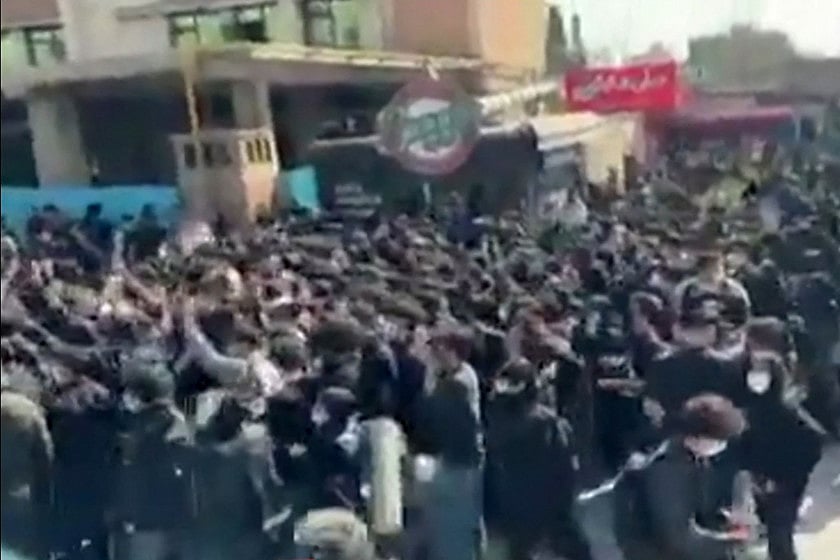
CNN describes an intensified crackdown on dissent, including mass arrests and suppression of protests, amid concerns that external conflict could trigger domestic instability. Iranian officials have frequently cited foreign interference and espionage threats to justify such actions.
Naval drills and strategic signalling
Iran has also conducted maritime exercises designed to highlight its ability to disrupt regional waterways.
Iranian forces temporarily restricted portions of the Strait of Hormuz during naval drills — a symbolic demonstration given the chokepoint’s importance to global oil flows.
Joint naval exercises with Russia and expanded wargaming activities underscore Tehran’s focus on asymmetric leverage rather than direct force parity.
Deterrence message to Washington
Experts quoted by CNN say Iran’s posture reflects an attempt to raise the perceived cost of conflict.
“The Iranian tactic is trying to convince the United States that war is going to be costly,” Vali Nasr of Johns Hopkins University told the network, suggesting Tehran’s actions are calibrated to shape US strategic calculations.
Strategic picture
While diplomacy remains technically active, Iran’s visible defensive preparations, infrastructure fortification and force reconstruction highlight the fragility of the current moment.
Taken together, the developments depict a state preparing for escalation even as negotiations continue — a dual-track reality now mirrored on both sides of the standoff.