
Table of Contents
Dubai: She was scouted on a subway platform in Brooklyn, had never heard of Bottega Veneta, and turned up to her first castings in free NYU T-shirts.
Less than two years later, Bhavitha Mandava is on the cover of British Vogue, the second Indian model to appear solo on its cover.
If this were a film script, someone would tell you it was unrealistic. But this is exactly how it happened.

The girl from Hyderabad
Mandava was born and raised in Hyderabad, India, in what she describes as a deeply academic household where success meant studying hard, getting good grades and securing a stable career. Following that blueprint to the letter, she moved to New York to pursue a Master of Science in Integrated Design and Media at NYU, with ambitions firmly pointed towards technology and architecture.
Modelling was never part of the plan. Not even close.
The subway moment that changed everything
The turning point came in the most wonderfully cinematic way possible. Just two weeks before Bottega Veneta’s Spring/Summer 2025 show, a scout from 28Models approached Mandava on the subway. She said no. The scout came back. Mandava said no again. It was only when the scout mentioned that modelling could help pay off her student debt that she finally reconsidered.
Her photos were sent to casting director Anita Bitton, who showed them to Matthieu Blazy, then creative director at Bottega Veneta. Blazy cast her on the spot. Two weeks later, Mandava made her runway debut at Bottega Veneta, walking confidently in a simple white oversized shirt over a pleated skirt. She had never heard of the brand before the casting. It was only the second time in her life she had walked in heels.
In her British Vogue cover interview, she laughed recalling those early days. “My agent still roasts me about the fact that I used to go to castings dressed in jeans and NYU T-shirts that I’d got for free. I just showed up in whatever was clean.” She also remembered that the Bottega casting was “the second time I’d walked in heels, like, maybe ever, in my entire life.”
Balancing runways and revision
What makes Mandava’s story particularly remarkable is what she refused to give up along the way. Despite a sudden and demanding modelling career, she continued attending classes, keeping her campus job at NYU MakerSpace and flying to Europe every weekend to walk in shows.
She has spoken about the difficulty of balancing travel with deadlines, whilst also holding onto her campus job as a lab coordinator because that was where her friends were. In May 2025, she graduated with two degrees: a Bachelor of Architecture and a Master’s in Integrated Design and Media. By that point, she had already walked for Bottega Veneta, Dior and Chanel.
A full circle moment at Chanel
When Matthieu Blazy was appointed Chanel’s new artistic director in late 2024, Mandava followed him to the iconic French house. Then came the moment that would change everything.
Blazy chose Mandava to open Chanel’s Métiers d’Art show, staged in an abandoned subway station in New York. It was a breathtaking full-circle moment. The model who had been discovered underground was now opening one of fashion’s most prestigious shows in an underground setting, dressed by Blazy in a beige quarter-zip jumper and stonewashed jeans, a deliberate nod to the outfit she was wearing when she was first scouted.
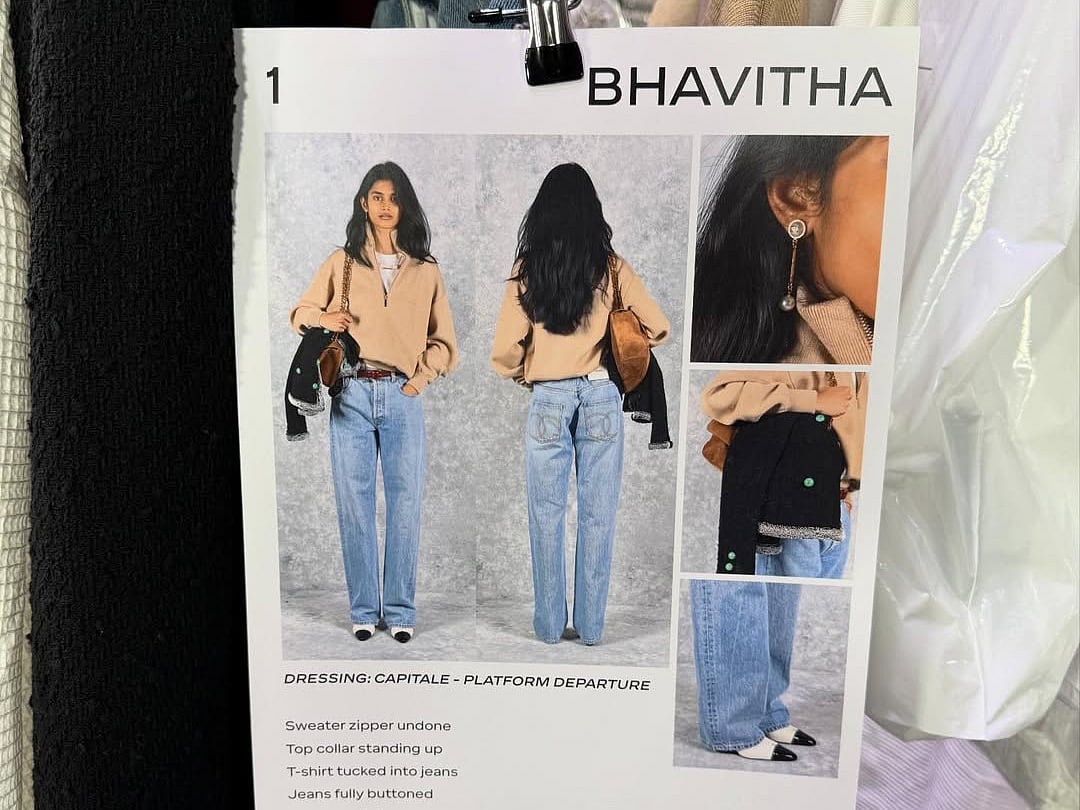
Speaking to British Vogue about the experience, Blazy described Mandava as “confident, enthusiastic and very involved,” adding of that iconic opening look: “That outfit wasn’t only about Chanel, it was also about her.”
Mandava became the first Indian model to open a Chanel show. She shared a video of her parents watching the livestream from their sofa at home, her mother squealing with delight and clapping whilst her father beamed quietly with pride. The clip went viral within hours.
The British Vogue cover
The March 2026 cover of British Vogue, photographed by Oliver Hadlee Pearch, shows Mandava mid-laughter, radiant and completely unguarded. On set, she arrived as what the magazine described as a Disney Princess-sized cyclone of colour, twirling under the lights in a tie-dye chiffon Ashish maxidress, bouffant hair teased towards the heavens. The joy captured in the final image is not incidental. It is the whole point.
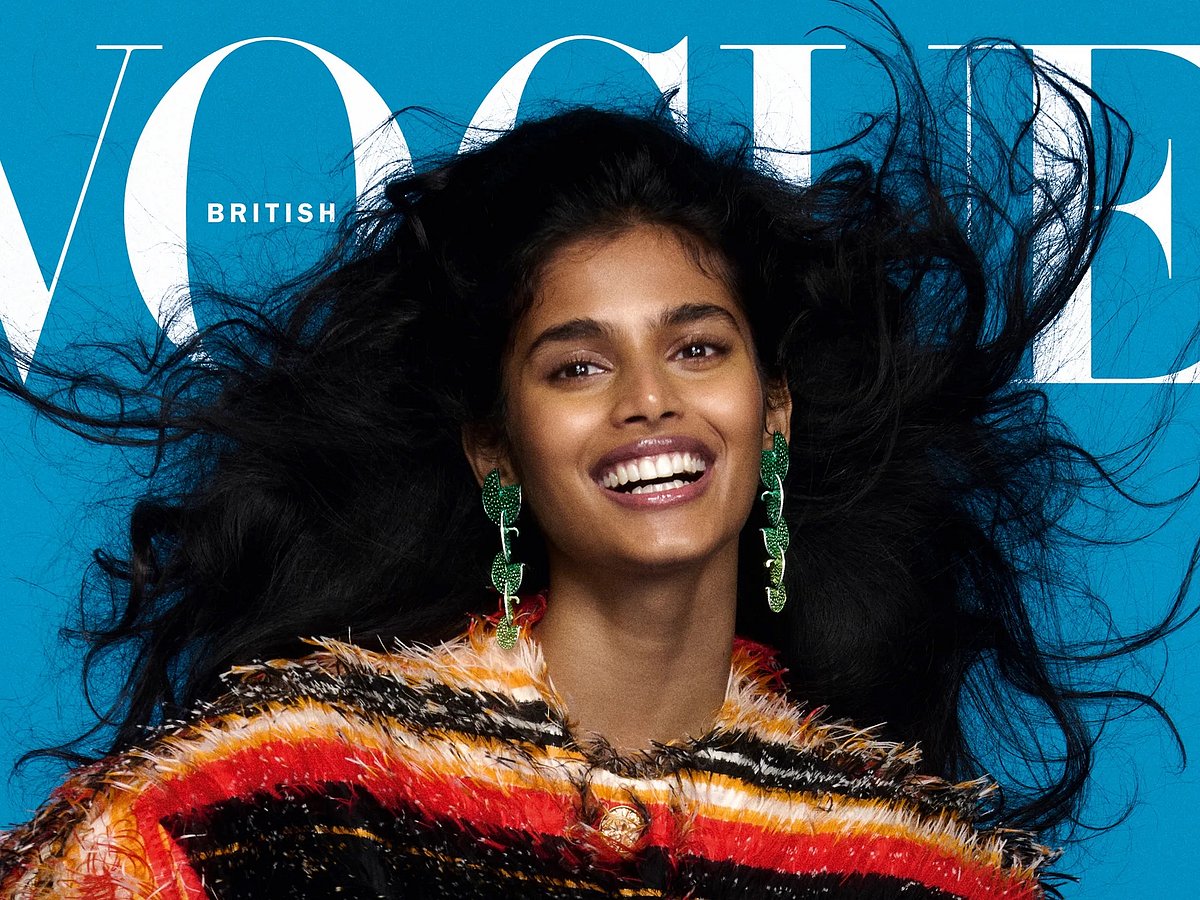
British Vogue editor Chioma Nnadi describes her rise in her editor’s letter as a “fashion fairy tale,” and it is difficult to argue with that framing. In her Vogue interview, Mandava reflected on what the cover means beyond the personal milestone. “Opening the Chanel show was deeply personal to me, and then suddenly it became symbolic in a way I didn’t expect,” she told the magazine. “In the West, it touched on this question of who gets to be included in the idea of beauty and whether Indian women are even allowed to be seen as traditionally beautiful.”
She is only the second Indian woman to appear solo on the cover of British Vogue, following Priyanka Chopra Jonas. But what sets Mandava apart is that she arrives on this cover as a fashion model first, not a crossover celebrity. Fashion found her on a subway platform, and she grew into this moment authentically, one casting at a time.
More than a pretty cover
Mandava is acutely aware of what her visibility means to others, particularly to young South Asian women who have rarely seen themselves represented at this level of the fashion world.
In her Vogue interview, she spoke warmly about the messages she receives from mothers who show their daughters her photos. “I’ve got so many emails from people who say my success feels like a personal win for them,” she said. “There are mums who tell me they show their daughters my photo and it makes these little brown girls feel better about their skin tone.”
She also addressed colourism directly and thoughtfully, noting that some critics said she looked like “any girl on the street” because of her darker skin tone. “In India, colourism is really so deep-rooted,” she told Vogue. “I don’t think it’s really about me. It’s culture renegotiating itself.”
Casting director Anita Bitton, who first introduced Mandava to Blazy, reflected on the broader significance to British Vogue: “To be able to redefine beauty norms takes trust and I see a lot of that right now.”
A real diamond in the rough
Mandava didn’t set out to become a fashion icon. She set out to pay her student debt and finish her degree. The industry found her precisely because she wasn’t trying to be found, and her authenticity has remained intact every step of the way.
As she prepares to walk in Chanel’s couture show as the Chanel bride, the most prestigious honour on any runway, she remains exactly who she was on that Brooklyn subway platform: a girl from Hyderabad with a brilliant mind, an extraordinary smile and absolutely no idea how to walk in heels.
She figured it out. And in doing so, she has opened a door that will never fully close again.
Areeba Hashmi is a trainee at Gulf News.